

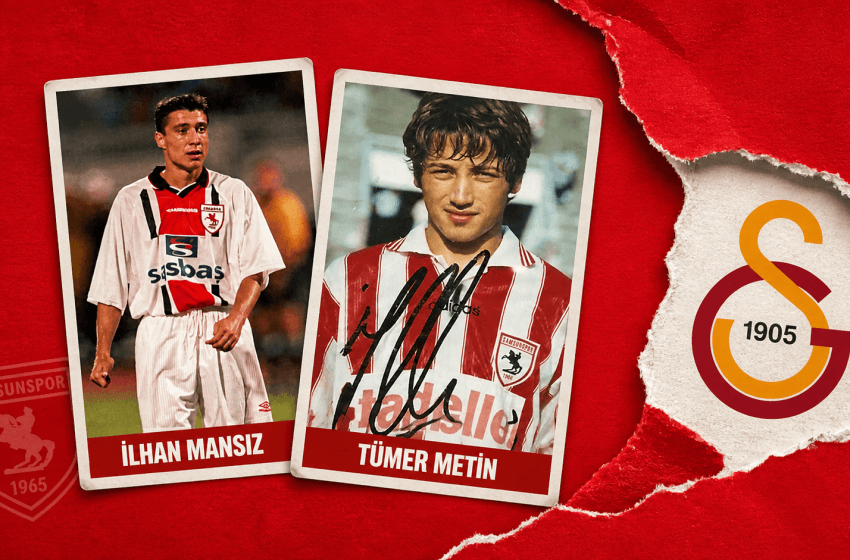
The Turkish Football Transfer Tango: Ilhan Mansiz and Tumer Metin’s Galatasaray Rollercoaster
There are transfer sagas.
Then there is Turkish football in the late 1990s, which operated somewhere between organised sport, political thriller, and a family argument conducted through fax machines.
The story of İlhan Mansız and Tümer Metin nearly joining Galatasaray belongs firmly in that category.
What makes the whole affair even better is this: neither of them actually played a competitive match for Galatasaray. Yet somehow, the club still played a massive role in shaping both careers.
And naturally, Samsunspor were sitting right in the middle of the chaos.
Back then, Samsunspor had become one of Turkish football’s great talent factories. Before Anadolu clubs became polished scouting operations with PowerPoint presentations and data analysts called Emre in slim-fit shirts, Samsunspor were simply producing footballers the old-fashioned way: by throwing talented young men into difficult matches and hoping they survived long enough to become stars.
İlhan Mansız looked like Turkish football’s answer to an Italian centre-forward. Tall, elegant, technically gifted, and carrying himself with the sort of confidence that suggested he probably owned several leather jackets. Alongside him was Tümer Metin, another future Beşiktaş cult hero with enough left-footed technique to make defenders question their career choices.
Naturally, Istanbul came calling.
Galatasaray moved first.
At the time, Galatasaray were transforming into a European powerhouse under Fatih Terim. The UEFA Cup triumph was around the corner. Everybody wanted in. And according to İlhan himself, the deal was effectively done.
“I had already reached an agreement with Galatasaray,” Mansız later explained. “I had signed everything.”
Simple enough.
Except this being Turkish football, a straightforward transfer was never remotely possible.
Mansız later discovered that fellow gurbetçi striker Ümit Karan had also signed for Galatasaray, apparently on far better financial terms. That immediately complicated matters. Samsunspor also wanted proper compensation. Then, just as the situation became increasingly messy, the phone rang.
The call came from Beşiktaş.
Specifically, from a footballing universe featuring Sinan Engin, backroom manoeuvres, emotional persuasion, and enough transfer intrigue to fill an entire season of Kurtlar Vadisi.
“Would you like to play for Beşiktaş?” they asked.
For İlhan Mansız, this was essentially asking a football-obsessed Turkish kid whether he fancied starring for his childhood club at İnönü in front of forty thousand furious supporters hurling sunflower seeds and existential despair at rival defenders.
Galatasaray suddenly became yesterday’s news.
The financial difference between the offers was minimal anyway. The emotional difference was enormous. Mansız chose Beşiktaş.
Simple again, right?
Absolutely not.
Because Turkish football at the time had one final boss level left: licensing chaos.
Despite signing for Beşiktaş, Mansız and Tümer Metin found themselves trapped in bureaucratic limbo. Their registrations became tangled in a transfer dispute involving Samsunspor, Galatasaray, and the wonderfully chaotic administrative structures of Turkish football before things became slightly more professional.
Slightly.
The pair missed training camps. They joined pre-season work late in Köln. Mansız later admitted he barely played in friendlies because nobody knew whether he would actually be eligible to play football.
Two days before the start of the season, neither player had received clearance.
At this point, the situation descended into proper Turkish football absurdity.
Mansız and Tümer reportedly threatened to leave for a foreign club they had previously signed documents with. Training sessions were boycotted. Executives scrambled around Istanbul trying to solve the situation before opening weekend arrived and newspapers exploded into hysteria.
Then came the rescue mission.
Enter Ergün Gürsoy and Sinan Engin.
According to Mansız, Beşiktaş manager Sinan Engin convinced Galatasaray executive Ergün Gürsoy to help resolve the crisis. Which sounds completely insane now, but Turkish football in those years often operated on personal relationships, midnight meetings, and the sort of handshake diplomacy usually associated with Cold War spy exchanges.
And this is where Turkish football’s legendary “hülle” system enters the story.
For younger readers unfamiliar with the era, hülle was basically Turkish football’s answer to “we’ll figure it out later”.
The Bosman ruling had already changed European football, allowing out-of-contract players to move freely between clubs. Most of Europe adapted.
Turkey, naturally, found a workaround instead.
Under the regulations at the time, a player could leave for free abroad, but domestic transfers were far more complicated. So clubs invented a solution worthy of a bloke running a photocopy shop behind a bus station.
A player would officially sign for a small European club first, often one nobody had actually seen play football, before magically reappearing days later at the Turkish club who wanted him all along.
Everybody understood what was happening.
Everybody pretended they didn’t.
It was football bureaucracy performed with a perfectly straight face.
Eventually, the paperwork cleared. Beşiktaş paid Samsunspor. The licences arrived just before kickoff. Crisis over.
Well, technically.
Because the funniest part of the whole saga is what happened next.
İlhan Mansız and Tümer Metin both became deeply associated with Beşiktaş culture. Mansız evolved into one of the most iconic forwards of the early 2000s, eventually reaching global fame during Turkey’s extraordinary 2002 World Cup run. Tümer later became one of the league’s most gifted and controversial playmakers.
Yet both men carry this bizarre footnote in their careers: they almost joined Galatasaray first.
Looking back now, the entire affair feels impossibly Turkish.
Two future Beşiktaş cult heroes nearly ending up at Galatasaray. Samsunspor caught in the middle. Endless paperwork crises. Last-minute licences. Secret foreign-club manoeuvres. Rival executives helping each other solve transfer disasters behind closed doors.
Modern football has release clauses, sporting directors, and carefully curated social media announcements with moody piano music.
Turkish football in the late 90s/early 2000s had chaos, cigarettes, and transfer negotiations conducted like hostage exchanges.
Frankly, it was far more entertaining.