

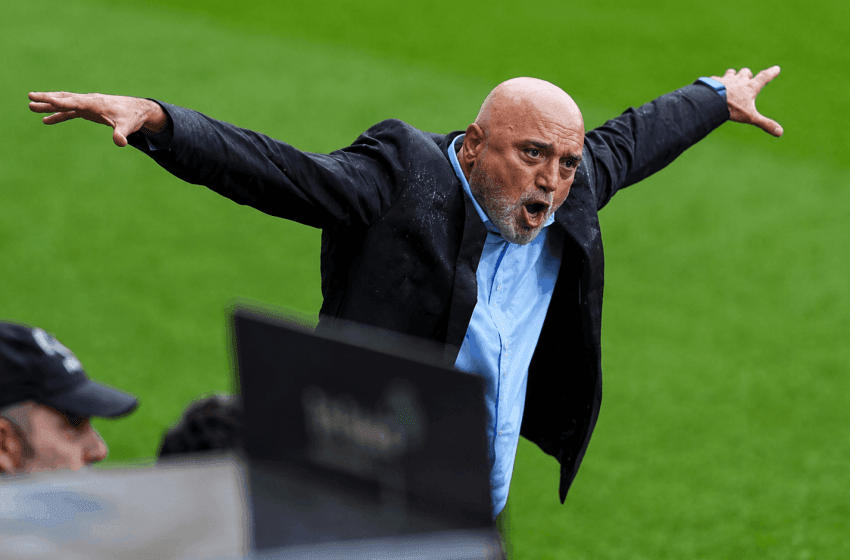
Turkish Football’s Greatest Football Nerd
Outside Turkey, Hikmet Karaman is probably unknown to most football fans.
Inside Turkey, though, he’s been around forever.
Gaziantepspor. Kocaelispor. Antalyaspor. Rizespor. Kayseri. Malatya. Adana. Erzurum. If you watched Turkish football any time between the late 90s and now, Hikmet Karaman eventually appeared somewhere on your television — usually wearing a tracksuit, usually furious about something.
At first glance, he looks exactly like the kind of manager Turkish football mass-produces:
emotional,
combative,
constantly arguing with referees,
capable of delivering a seven-minute touchline rant over a throw-in.
Then you actually listen to him speak.
That’s when things become interesting.
Because underneath all the Anadolu football chaos, Hikmet Karaman sounds less like a career Süper Lig survivor and more like a man who spent 30 years trying to audit football itself.
One of the best stories in the interview involves Holger Osieck.
For younger readers: Osieck was not some random foreign coach imported for vibes. He was a serious figure in German football. Assistant to Franz Beckenbauer during West Germany’s World Cup-winning era. Later managed Canada and Australia. Highly structured. Highly German. Football treated almost like engineering.
Hikmet Karaman worked under him as an assistant coach at Kocaelispor.
The culture clash was immediate.
Osieck reorganised the training ground like a military facility. Massage rooms moved. Schedules enforced. Everything timed properly. Hikmet describes players behaving like confused university students during the first week.
Then came the real test.
Kocaelispor went 2-0 down against İstanbulspor.
Osieck’s instinct was control. Structure. Don’t panic.
Hikmet’s instinct was basically:
“Hocam, we’re already dead. At least attack.”
He starts suggesting more aggressive substitutions. Osieck gets irritated immediately. Conversation finished.
Then, quietly, later in the match, Osieck makes almost the exact same changes anyway.
Kocaelispor come back and win 3-2.
That entire story feels like Turkish football compressed into 90 minutes:
German order colliding with Turkish improvisation.
The strange thing about Hikmet Karaman is that he never talks like somebody satisfied with merely coaching in Turkey.
Throughout the interview, he keeps drifting toward football education.
Not coaching badges.
Not management clichés.
Actual football curiosity.
He talks about visiting Brazil and sitting down with Luiz Felipe Scolari. The meeting was apparently meant to last half an hour.
Five hours later, they were still talking.
Anybody who has spent time around football obsessives understands this immediately. One tactical conversation becomes another. Somebody brings up pressing. Somebody mentions defensive spacing. Suddenly it is dark outside and nobody has touched their tea in an hour.
That’s the energy Hikmet Karaman gives off constantly.
He speaks about football like somebody still trying to learn it.
At another point, he casually mentions visiting training sessions in Brazil and comparing them mentally with European football.
That part is fascinating because he isn’t romantic about South America at all.
He doesn’t come back talking about samba football or street football mythology.
Instead, he notices structure.
Brazilian players, he says, are technically unbelievable. But many tactical habits only develop after moving to Europe. Argentina produces different player profiles. Paraguayans adapt naturally to Italy because the football there is more physical and contact-heavy.
You can almost hear his brain processing everything in real time.
This isn’t football nostalgia.
This is football pattern recognition.
Then the interview takes an unexpectedly sad turn.
Hikmet mentions that through Jordi Cruyff, there was once a possibility of bringing Johan Cruyff into the orbit of Antalyaspor.
Nothing happened.
Money issues.
Turkish football being Turkish football.
But years later, Hikmet still sounds disappointed.
Not because he missed a famous name.
Because he missed access.
That’s the revealing detail.
He openly wonders whether building a relationship with Cruyff could have changed his own coaching path in Europe.
Most football people remember failed transfers financially.
Hikmet remembers them educationally.
The Ronaldo section tells you even more about him.
When Hikmet Karaman speaks about Cristiano Ronaldo, he barely talks about trophies.
Instead, he talks about the gym.
The private gym.
The recovery work.
The extra sessions.
The discipline.
Then he starts connecting it to players he coached himself:
İbrahim Üzülmez staying behind after training,
Cenk Tosun taking hundreds of shots after sessions,
players repeating movements long after everyone else had gone home.
That’s what impresses him.
Work.
Repetition.
Accumulation.
You start realising Hikmet Karaman probably admires obsessive workers more than naturally gifted footballers.
Which, honestly, explains how he lasted this long in Turkish football.
Because Turkish football is not a calm environment for reflective people.
Every week is emotional.
Every defeat becomes personal.
Every manager eventually turns into a public argument.
Most coaches end up shrinking their world:
survive the next match,
survive the next president,
survive the next headline.
Hikmet Karaman somehow kept his curiosity intact through all of it.
That’s the unusual part.
Not the touchline shouting.
Not the old-school Süper Lig chaos.
Turkey has produced hundreds of those.
The unusual part is that after decades inside one of football’s loudest environments, he still sounds like somebody sitting at the back of the classroom taking notes.